
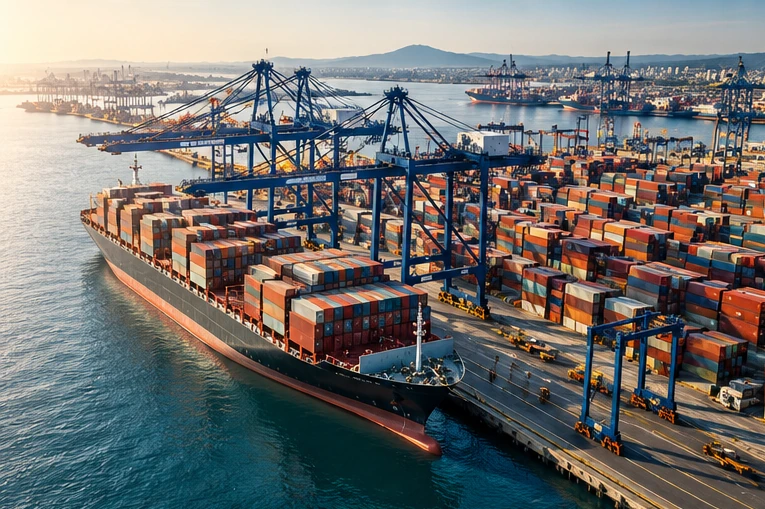
China has several major production and export clusters; one quoted “China port” is not interchangeable with another. Shanghai–Ningbo, Pearl River Delta gateways and northern ports serve different factories and container drayage markets.
Seaports and air cargo gateways
Factories around Suzhou and the Yangtze River Delta may consider Shanghai or Ningbo; Shenzhen/Guangzhou are relevant to southern manufacturing corridors. A factory near Qingdao needs a northern-gateway comparison rather than an automatic South China departure.
Selected sea gateways used for initial planning: Shanghai (CNSHA), Ningbo (CNNGB), Shenzhen (CNSZX), Qingdao (CNTAO). These codes are location references, not proof of a particular vessel call or a terminal booking. Airports worth checking for a relevant cargo schedule include PVG, CAN, SZX (IATA). Confirm live service, terminal, restrictions and airport cargo facilities before booking.
Where the cargo actually needs to go
Electronics, machinery, household goods and automotive supply chains have different consolidation and inspection requirements. Confirm the actual factory address, export capability and seller’s responsibility for delivery to the nominated terminal.
Inland-delivery detail that belongs on the booking instruction: Request exact factory pickup address, exporter-of-record arrangement, cargo ready date, lithium battery declarations where relevant and complete commodity detail. A port or airport name alone is not an adequate delivery address; include the consignee's receiving rules in the first quote request.
Choosing sea, air, road or intermodal
FCL works where cargo volume and shipper loading support a container; LCL adds consolidation handling. Air cargo at PVG, CAN or SZX is a separate solution for cargo that justifies chargeable-weight cost.
Supplier-made documents can describe goods inconsistently across the invoice, packing list and booking. Confirm carton counts, gross weights, battery status and any restricted item classification before a container reaches the terminal.
Customs responsibility and documents
The General Administration of Customs of China publishes customs policies and procedures. Classification, export controls, inspection and licensing depend on the product; verify with the Chinese exporter and appointed broker before stating documents are sufficient.
Agree in writing who is the importer/exporter of record, who prepares declarations, and who pays duties, handling and destination fees. Commodity classification, origin and any required licence must be checked against current official instructions; this guide does not provide a customs decision.
A practical route-planning example
For packaged electrical components leaving a factory near Suzhou, compare Shanghai or Ningbo with drayage and cargo-ready deadlines. An urgent subset could use PVG air freight while bulk replenishment ships by sea if permissible.
Make the rate comparison consistent: same packed goods, same origin and delivery point, same Incoterms® rule, same expected delivery condition and a clear list of excluded charges. Published transit times and prices have intentionally not been guessed here.
Official references and editorial checks
Reference details were reviewed for this editorial update on 25 October 2026. Authority rules, terminal services, code assignments and import restrictions can change. Check the official source and your appointed broker or carrier before a shipment is tendered.
Related tools and next reading
For a China shipment, use the appropriate mode guide and calculator to prepare dimensions before approaching a provider. These links help with planning; they do not represent live capacity or an approved booking.